 Ahmad
Ahmad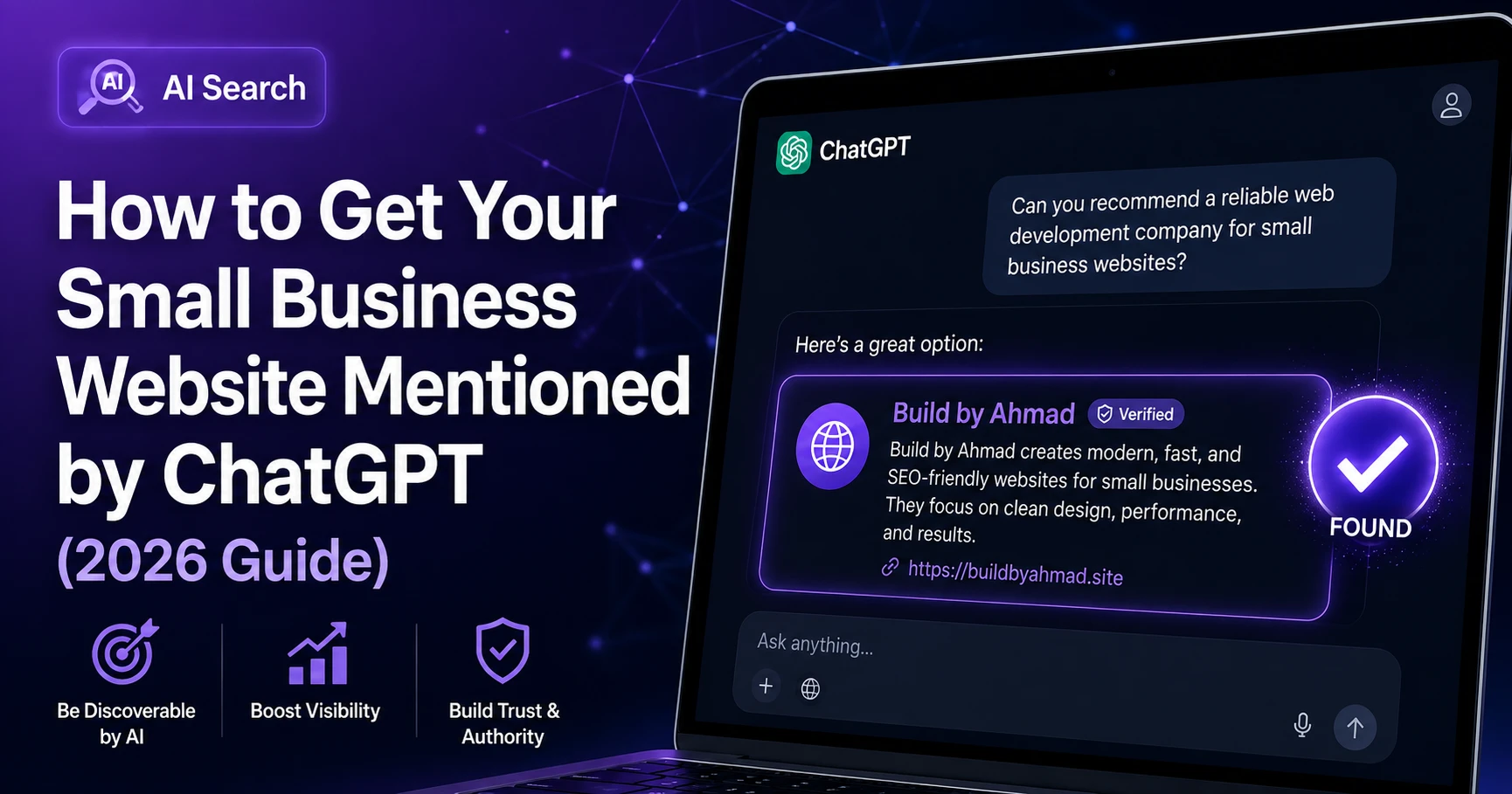
Quick Answer: To rank in ChatGPT, your website needs strong traditional SEO first, since ChatGPT and other AI tools pull from search engines and trusted web sources. On top of that, focus on clear structure, direct answers near the top of your pages, consistent business information across the web, and genuine mentions from other credible sites. There's no separate "ChatGPT algorithm" to game — it's SEO plus clarity.
Ever asked ChatGPT something like "best dentist near me" or "good web developer in my city" and wondered how those specific businesses got picked? It's not random, and it's not paid placement either.
More and more customers are skipping Google entirely and asking AI tools directly. If your business isn't showing up in those answers, you're invisible to a growing chunk of your potential customers.
That's exactly why how to rank in ChatGPT has become one of the most searched questions among small business owners in 2026. This guide breaks down exactly what actually works, without the vague "just do good SEO" advice.
What Does "Ranking in ChatGPT" Actually Mean?
Ranking in ChatGPT isn't like ranking on a Google results page with ten blue links. There's no single spot to fight for — it's about whether your business gets mentioned at all when someone asks a relevant question.
ChatGPT pulls answers from two places: its trained knowledge and, when browsing is enabled, live web search results. If your site isn't well-optimized or well-known online, it simply won't come up as an option.
AI search optimization for small business websites means making sure your site is easy for both search engines and AI tools to find, understand, and trust enough to recommend.
Why This Matters More Than Most Business Owners Realize
This isn't a future problem — it's already changing how people find local businesses right now.
• Search volume is shifting fast. More people are asking AI tools direct questions instead of scrolling through search results.
• AI answers skip straight to a shortlist. If you're not on that shortlist, a customer may never see your business at all.
• Early movers have an advantage. Very few small businesses have optimized for this yet, so there's real opportunity right now.
• It's connected to your existing SEO. Improving your AI visibility largely means improving your regular SEO too — it's not extra work in a separate direction.
• Trust signals matter more than ever. AI tools lean heavily on consistency and credibility, which rewards businesses that do things properly.
Ignoring this now just means playing catch-up later, once everyone else has figured it out.
How to Rank in ChatGPT: Step-by-Step
None of these steps require chasing a secret algorithm. They're about becoming a source AI tools can confidently point to.
Step 1: Get Your Core SEO Right First
Make sure your site has clear titles, proper headings, fast load times, and mobile-friendly design. AI tools depend on search engines to find you, so weak SEO blocks you before you even start.
Step 2: Answer Questions Directly, Near the Top of the Page
Add a short, clear answer to the main question of each page within the first paragraph. AI tools favor content that gets to the point instead of burying the answer under long intros.
Step 3: Structure Your Content Clearly
Use proper headings, short paragraphs, and lists where it makes sense. Clean structure makes it far easier for AI tools to pull accurate information from your page.
Step 4: Keep Your Business Information Consistent Everywhere
Make sure your business name, address, phone number, and services match exactly across your website, Google Business Profile, and any directories you're listed in. Inconsistent details reduce trust signals AI tools rely on.
Step 5: Earn Genuine Mentions on Other Websites
Getting mentioned on local news sites, industry directories, or partner websites builds the kind of credibility AI tools look for. This matters more than one-off backlinks from low-quality sites.
Step 6: Keep Your Content Updated
Refresh outdated pages, update statistics, and add a "last updated" note where relevant. AI tools tend to favor content that looks current over content that hasn't been touched in years.
Step 7: Make Your Google Business Profile Work Harder
Fill out every section, add real photos, and keep your hours and services accurate. A strong, active profile feeds directly into how AI tools understand and trust local businesses.
If you're not sure where your current site stands, it's worth reading through [our guide on how long it takes to build a website](https://buildbyahmad.site/blog/how-long-does-it-take-to-build-a-website-the-honest-timeline) to see whether a rebuild or a refresh makes more sense before you invest time in AI optimization.
Real Benefits of Optimizing for AI Search
Getting this right pays off in ways that go beyond just showing up in a ChatGPT answer.
• More qualified leads, since people asking AI tools are often further along in deciding.
• A head start on competitors, most of whom haven't touched this yet.
• Stronger overall SEO, since the steps above improve your regular Google rankings too.
• More trust with customers, who see your business recommended by a source they already trust.
• Less reliance on paid ads, since AI mentions are earned, not bought.
• Longer-lasting visibility, since AI tools favor consistency over short-term tricks.
Common Mistakes Businesses Make With AI Search Optimization
Most businesses don't fail here because they ignore SEO completely. They usually miss a few specific things that matter most for AI visibility.
Mistake 1: Treating AI Search as Separate From SEO
Some businesses look for a totally different strategy instead of strengthening what already works for search engines.
Fix: Focus on solid, fundamental SEO first — that's the foundation AI tools build on.
Mistake 2: Burying the Answer Deep in the Content
Long, vague introductions before getting to the actual point make it harder for AI tools to extract a clear answer.
Fix: Lead with a direct, short answer near the top of every important page.
Mistake 3: Inconsistent Business Details Across the Web
Different addresses, phone numbers, or business names across listings quietly damage trust signals.
Fix: Audit your listings and match every detail exactly across your website and directories.
Mistake 4: Letting Content Go Stale
Old, outdated pages signal to AI tools that a business may not be active or current.
Fix: Set a habit of reviewing and refreshing your key pages every few months.
Traditional SEO vs. AI Search Optimization: Quick Comparison
|
Factor |
Traditional SEO |
AI Search Optimization |
|
Main goal |
Rank in search results |
Get mentioned in AI answers |
|
Key signals |
Keywords, backlinks, speed |
Clarity, consistency, trust |
|
Content style |
Can be longer, keyword-focused |
Direct answers, clear structure |
|
Overlap |
High |
High — mostly the same foundation |
|
Competition |
High, well-established |
Still relatively low right now |
Pro Tips to Improve Your AI Search Visibility
• Write like you're answering a real question, not writing for a search engine.
• Use FAQ sections on key pages — AI tools pull directly from these often.
• Check what ChatGPT already says about your business or industry to see where the gaps are.
• Keep your Google Business Profile active, with regular updates and real photos.
• Ask happy customers to mention your business online, not just leave a star rating.
• Don't chase tricks — consistency and clarity outperform shortcuts every time.
Why Build by Ahmad Can Help With This
Getting AI search visibility right takes more than a single blog post — it starts with a website built on solid technical SEO from day one.
Build by Ahmad builds fast, clean, well-structured sites for clients across Pakistan, the USA, UAE, and Australia, with the exact foundation AI tools and search engines both reward.
If your current site is holding your AI visibility back, that's usually a sign it's time for a technical review, not just a content refresh.
Frequently Asked Questions
Is there a specific algorithm to rank in ChatGPT?
No, there isn't a separate ranking algorithm like Google's. ChatGPT relies on strong traditional SEO and trusted web sources, so improving your regular SEO is the most reliable way to improve AI visibility too.
How long does it take to start showing up in AI search results?
There's no fixed timeline, but most businesses see improvements over a few months of consistent effort, similar to traditional SEO. Sites with strong existing SEO tend to see AI visibility improve faster.
Do I need a big budget to optimize for AI search?
No, most of the steps involve improving content clarity, consistency, and basic SEO, which don't require a large budget. The main investment is time and attention to detail, not expensive tools.
Does my Google Business Profile really affect ChatGPT visibility?
Yes, especially for local businesses. AI tools often lean on the same trust signals search engines use, and a complete, active Google Business Profile is a major part of that.
Can a small business really compete with big brands for AI mentions?
Yes, especially locally. Big brands dominate broad searches, but AI tools frequently favor specific, well-optimized local businesses for location-based questions.
Should I stop focusing on Google SEO to focus on AI search instead?
No, the two are deeply connected rather than competing priorities. Strong Google SEO is the foundation that makes AI search visibility possible in the first place.
Final Thoughts: Get Found Before Everyone Else Catches On
Right now, very few small businesses have optimized for how to rank in ChatGPT, which means the ones who start today have a real head start.
Begin with just one step — tightening up your Google Business Profile or adding clear, direct answers to your top pages. Small, consistent improvements now put you ahead before this becomes as competitive as regular SEO already is.
The businesses showing up in AI answers a year from now are the ones building the right foundation today.