 Ahmad
Ahmad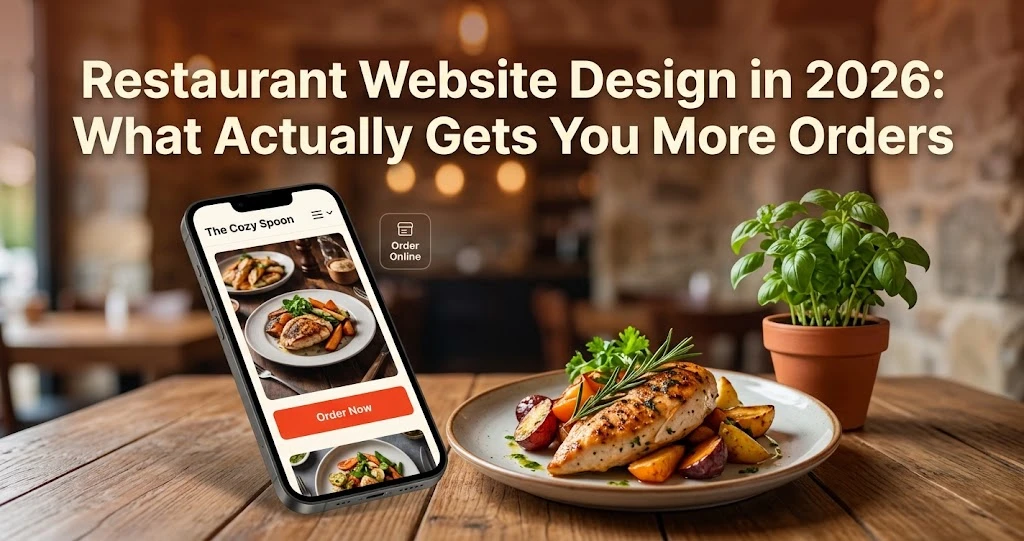
Quick Answer: A restaurant website that actually drives orders needs four things: a menu that's easy to scan on mobile, a working online ordering or reservation button above the fold, fast load times, and real photos instead of stock images. Good restaurant website design isn't about looking fancy — it's about getting a hungry person from "searching" to "ordering" in under 30 seconds.
Ever searched for a restaurant, landed on their site, and left within seconds because you couldn't find the menu or a way to actually order? You're not alone — and your restaurant's website might be doing the exact same thing to hungry customers right now.
Most restaurant websites look fine at a glance but quietly lose orders because of small, fixable problems. A slow menu page, a missing "Order Now" button, or a site that's painful to use on a phone can cost more business than a bad review ever would.
This guide breaks down exactly what restaurant website design should actually include in 2026 — not design trends, just what gets people from browsing to ordering.
What Does Good Restaurant Website Design Actually Mean?
Good restaurant website design isn't about flashy animations or a beautiful hero image, even though those help. It's about removing every bit of friction between a hungry visitor and a completed order.
Most people land on a restaurant site with one of three goals: check the menu, place an order, or book a table. If your site doesn't make those three things obvious within seconds, you're losing customers to a competitor's site instead.
Think of your website less like a brochure and more like a digital host — it should greet visitors, show them what they want, and guide them straight to ordering.
Why This Matters More Than Most Restaurant Owners Realize
A slow or confusing website doesn't just look unprofessional — it directly costs you orders and revenue.
• Most searches happen on mobile. If your site is hard to use on a phone, you're losing the majority of potential customers before they even see your menu.
• Delivery apps take a cut of every order. A website that drives direct orders keeps more of your revenue instead of paying 15–30% commission to third-party apps.
• First impressions happen fast. Most visitors decide whether to stay or leave within the first few seconds of loading your site.
• Your menu is your best sales tool. A hard-to-read or outdated menu page actively pushes hungry customers toward a competitor.
• Reviews and hours build trust before the first bite. Customers check your site to confirm you're open and legitimate before ever walking in or calling.
Your website is often the very first impression a customer has of your restaurant — before the food, before the service, before anything else.
Restaurant Website Design: What to Get Right, Step by Step
Here's exactly what to prioritize when building or improving a restaurant website.
Step 1: Put Your Menu Front and Center
Your menu should be one click away from the homepage, not buried in a dropdown or hidden inside a PDF. A clear, scrollable, mobile-friendly menu page converts far better than a downloadable file.
Step 2: Make Ordering or Booking the Obvious Next Step
Your "Order Online" or "Reserve a Table" button should be visible without scrolling, on every page, not just the homepage. If a customer has to hunt for it, you've already lost some of them.
Step 3: Use Real Photos, Not Stock Images
Real photos of your actual dishes, your space, and your team build far more trust than generic stock photography. Customers can usually tell the difference, and it affects how much they trust the rest of your site.
Step 4: Optimize for Speed on Mobile
A slow-loading menu page is one of the fastest ways to lose a hungry, impatient visitor. Compress images and keep the design clean so pages load quickly, especially on mobile data.
Step 5: Keep Hours, Location, and Contact Info Impossible to Miss
Put your hours, address, and phone number in the header or footer of every page, not just a separate contact page. Customers checking if you're open right now shouldn't have to dig for it.
Step 6: Connect Online Ordering Directly to Your Site
Whether it's your own ordering system or an embedded third-party tool, keep the ordering experience on your website instead of redirecting customers away entirely. This keeps more control — and more revenue — in your hands.
If you're weighing whether a full website or a simpler option makes more sense for your restaurant right now, our guide on [landing page vs website](https://buildbyahmad.site/blog/landing-page-vs-website-which-one-does-your-business-actually-need) breaks down exactly when each one fits.
Real Benefits of a Well-Designed Restaurant Website
Getting this right pays off in ways that show up directly in your order numbers.
• More direct orders, which means less commission paid to third-party delivery apps.
• Fewer phone-in errors, since online ordering removes miscommunication over the phone.
• Better first impressions, especially for customers discovering you for the first time.
• Stronger local SEO, helping you show up when nearby customers search for food.
• More table reservations, without relying entirely on phone calls during busy hours.
• A site that works while you sleep, taking orders and bookings outside business hours too.
Common Mistakes Restaurant Websites Make
Most restaurant sites don't fail because of bad food — they fail because of small, avoidable website mistakes.
Mistake 1: Hiding the Menu Inside a PDF
PDF menus are slow to load, hard to read on mobile, and painful to update every time prices or dishes change.
Fix: Use a proper web page for your menu that's easy to scan and simple to update yourself.
Mistake 2: No Clear Call-to-Action Above the Fold
If visitors have to scroll to find an "Order Now" or "Book a Table" button, many simply won't bother.
Fix: Keep your primary action button visible the moment the page loads, on both desktop and mobile.
Mistake 3: Outdated Hours or Closed Locations Still Listed
Nothing frustrates a hungry customer more than driving to a restaurant that's actually closed or has different hours than listed.
Fix: Review and update your hours and location details regularly, especially around holidays.
Mistake 4: Relying Only on a Social Media Page
A Facebook or Instagram page alone can't handle direct online ordering the way a proper website can, and algorithm changes limit who even sees your posts.
Fix: Use social media to drive traffic to your website, not as a replacement for one.
Restaurant Website Features: Must-Have vs. Nice-to-Have
|
Feature |
Priority |
Why It Matters |
|
Mobile-friendly menu |
Must-have |
Most visitors browse on their phone |
|
Online ordering button |
Must-have |
Directly drives revenue |
|
Real food photography |
Must-have |
Builds trust and appetite appeal |
|
Table reservation system |
Nice-to-have |
Reduces phone call volume |
|
Loyalty program integration |
Nice-to-have |
Encourages repeat orders |
|
Blog or events page |
Nice-to-have |
Helps with SEO over time |
Pro Tips for a Restaurant Website That Converts
• Keep your menu updated the moment prices or dishes change — an outdated menu quietly damages trust.
• Add customer reviews or ratings near your menu or ordering button for social proof.
• Highlight your bestsellers near the top of the menu page instead of burying them in a long list.
• Use high-quality photos for your top 5–6 dishes, even if you can't photograph the whole menu.
• Test your ordering flow on your own phone regularly to catch friction before customers do.
• Make sure your Google Business Profile matches your website exactly — hours, address, and phone number included.
Why Build by Ahmad Is a Good Fit for Restaurant Websites
A restaurant website needs to be fast, mobile-first, and built around one goal: turning hungry visitors into paying customers, not just a pretty online brochure.
Build by Ahmad builds clean, fast, conversion-focused websites for businesses across Pakistan, the USA, UAE, and Australia — including direct online ordering integration so more revenue stays with you instead of a delivery app.
If your current site is costing you orders instead of winning them, that's usually the clearest sign it's time for a redesign.
Frequently Asked Questions
How much should a restaurant website cost in 2026?
Costs vary widely depending on features like online ordering and reservation systems, but a solid custom restaurant website typically starts in the low hundreds and scales up with added functionality. It's worth comparing what's included at each price point rather than the number alone.
Do I really need online ordering on my own website?
Yes, if you want to keep more revenue instead of paying commission to third-party delivery platforms. Even a simple embedded ordering system on your own site can meaningfully reduce those fees over time.
Should my restaurant website replace my Instagram or Facebook page?
No, but it should be the primary destination, with social media used to drive traffic toward it. A website gives you full control that social platforms don't, especially when algorithms change.
How important are food photos on a restaurant website?
Very important — real, high-quality photos of your actual dishes significantly influence whether a visitor decides to order. Stock photos or no photos at all noticeably hurt trust and conversions.
Can a small local restaurant really benefit from a custom website?
Yes, especially for local search visibility and reducing dependence on delivery app commissions. Even a simple, well-built site can meaningfully increase direct orders for a small, single-location restaurant.
How fast should a restaurant website load?
Ideally under three seconds, especially on mobile, since slow menu pages are one of the fastest ways to lose an impatient, hungry visitor. Speed directly affects both conversions and how well your site ranks in local search.
Final Thoughts: Your Website Is Your Digital Host
Good restaurant website design isn't about chasing trends — it's about making it effortless for a hungry visitor to see your menu and place an order.
Walk through your own site right now, on your phone, the way a first-time customer would. If finding the menu or placing an order takes more than a few taps, that's exactly where you're quietly losing business.
Fix that friction, and your website starts working as hard as your kitchen does.